When Meaning Emerges Without Effort
A Psychological Reflection on Non-Ordinary Experiences of Trust, Insight, and “Non-Doership”
Abstract
This article explores a cluster of subjective experiences often labeled as enlightenment, deep intuition, or altered states of consciousness. Rather than interpreting them through spiritual or supernatural frameworks, the paper offers a clinical-psychological analysis of their shared structure. Drawing from meditation, hypnosis, symbolic imagery, and non-dual awareness, I propose that these experiences reflect a temporary reorganization of the self-model, leading to reduced self-referential processing, increased trust, and a felt sense of inevitability in action. The article aims to connect with individuals who have encountered similar states and are interested in exploring them through a grounded, integrative lens.
Introduction: Why Write About This at All?
Over time, I noticed a pattern in certain experiences I had across very different contexts: meditation, hypnosis, and moments that are often described—somewhat clumsily—as enlightened states.
What struck me was not their emotional intensity, but their structural similarity.
Despite different symbols, narratives, and emotional tones, these experiences shared a common core:
- a profound reduction in self-doubt
- a temporary suspension of the sense of “being the one in control”
- a deep reassurance that nothing needs to be managed right now
Importantly, these states did not last, nor did they leave me with beliefs about special abilities, prophecy, or authority. Instead, they left behind a quieter question:
What exactly is happening, psychologically, when this kind of trust appears?
This article is an attempt to answer that question—carefully.
Three Experiences, One Structure
Although the following experiences emerged in different contexts—meditation, symbolic imagery, and hypnosis—they share a strikingly similar internal architecture. What varies is the representational layer; what remains constant is the functional shift in self-related processing.
Rather than treating these experiences as isolated or exceptional, they can be understood as variations of the same underlying phenomenon: a temporary loosening of the self-model, accompanied by an increase in trust, immediacy, and non-effortful functioning.
1. Non-Dual or “Enlightenment-Like” Experience
(Experience without an owner)
In this experience, perceptual processes—seeing, hearing, bodily sensation—continued without disruption. There was no trance, dissociation, or loss of orientation. The environment remained ordinary. What changed was not what was perceived, but how perception was organized.
The usual sense of being a central observer or agent—the implicit “I” to whom experience happens—was absent. There was no effort to suppress thought, no attempt to focus attention, and no emotional numbing. Experience simply unfolded without commentary or ownership.
Clinically speaking, this resembles what is described in the literature as non-dual awareness or selfless awareness (Josipovic, 2014), characterized by:
- intact sensory clarity
- reduced narrative self-referencing
- absence of reflexive evaluation (“this is happening to me”)
- a sense of effortlessness rather than control
Importantly, this state did not persist. Identity and agency returned naturally, allowing normal functioning to resume. The experience was notable not because it replaced ordinary consciousness, but because it revealed—briefly—that ordinary functioning does not require continuous self-monitoring.
2. Symbolic Meditation Experience: Being Carried
(Trust replacing vigilance)
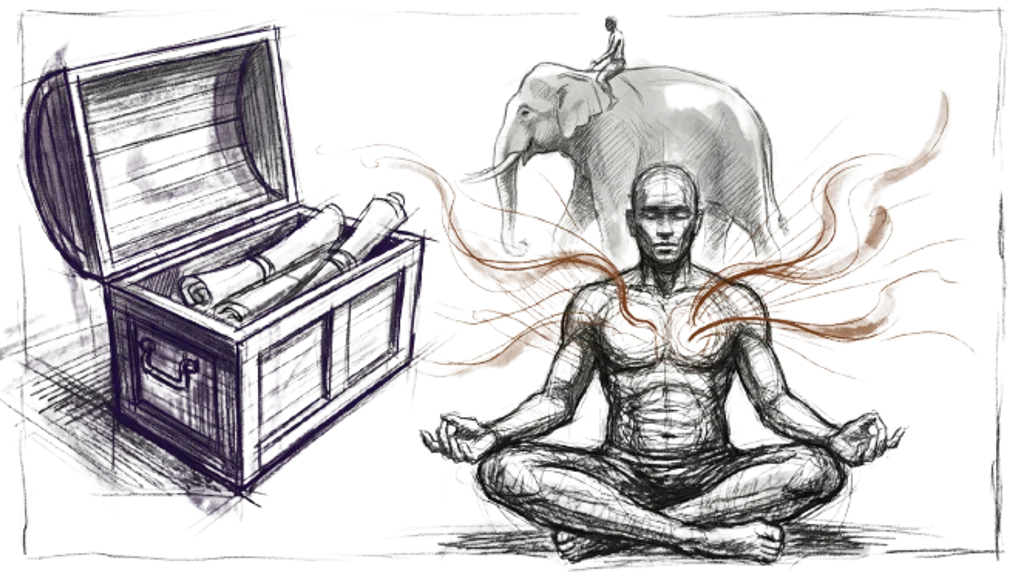
In a meditative context involving the symbolic figure of Ganesh, an image emerged of being carried on an elephant. The experience was accompanied by a clear, emotionally resonant message: “Everything is taken care of. You can relax.”
This message did not function as instruction or prophecy. Rather, it acted as a permission—specifically, permission to release responsibility for managing experience.
Immediately following this message, a state identical in structure to the non-dual experience described above emerged: effort dropped, self-referential thought quieted, and experience unfolded without a sense of authorship.
From a clinical and depth-psychological perspective, this imagery can be understood as symbolic containment. Containment imagery—being held, carried, supported, or protected—is frequently observed in therapeutic and meditative states when defensive vigilance relaxes (Jung, 1964; Hartman & Zimberoff, 2011).
The choice of symbol is culturally and personally conditioned. The function, however, is universal: to communicate safety and reliability at a level deeper than verbal reasoning.
The significance lies not in the figure itself, but in the regulatory effect of the message: reassurance replaced self-doubt, allowing the self-model to loosen temporarily.
3. Hypnosis and the Box with the Unreadable Message
(Implicit knowledge becoming explicit)
In a hypnotherapeutic setting, the experience involved opening a box without any suggestion regarding its contents. Inside appeared a parchment with writing that was initially unreadable. The letters were visible, yet their meaning remained inaccessible.
Only later—outside the hypnotic session—did the message become clear in its essence: “You are right.”
Several aspects of this experience are clinically relevant:
- The content was not suggested externally.
- Understanding did not occur immediately.
- The message was brief, non-directive, and context-sensitive.
In hypnosis and experiential psychotherapy, it is common for implicit or pre-verbal knowledge to surface symbolically before it becomes cognitively integrated (Kihlstrom, 2013). The delay between perception and understanding suggests a protective pacing mechanism: meaning emerged only when it could be assimilated without destabilization.
Crucially, the message did not convey grandiosity or omniscience. It did not imply universal correctness or special authority. Instead, it appeared to validate something far more modest—and far more essential: the legitimacy of one’s internal orientation.
As with the previous experiences, the effect was a reduction in self-doubt and internal conflict, rather than an increase in certainty about the external world.
In clinical hypnosis, delayed insight of this kind often reflects pre-verbal or implicit knowledge becoming cognitively accessible only after sufficient integration (Kihlstrom, 2013).
Structural Parallels Across All Three Experiences
Despite differences in imagery and context, the following shared features stand out:
- Reduction of self-referential processing
- Suspension of effortful control
- Replacement of doubt with trust
- Continuation of perception and action without a central “doer”
- Natural return of identity after the experience ends
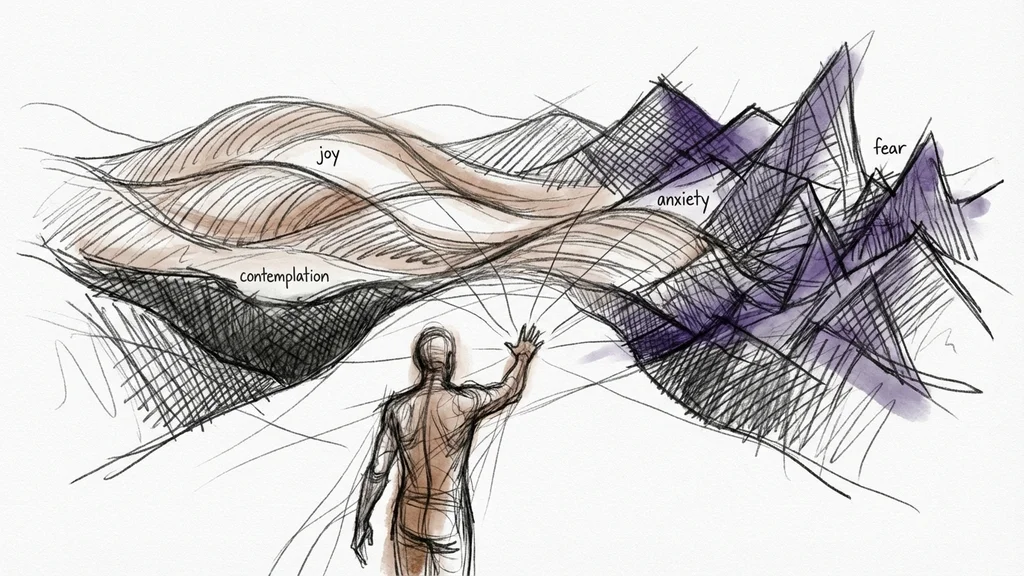
From a neuroscientific perspective, these features align with reduced dominance of the default mode network, which is associated with narrative self-processing and rumination (Brewer et al., 2011; Carhart-Harris et al., 2014).
Subjectively, this reduction can manifest as:
- intuitive clarity
- a sense of inevitability in action
- diminished internal conflict
- or the feeling that “things are happening on their own”
What is often interpreted as foresight, guidance, or external influence can be more parsimoniously explained as cleaner predictive processing in the absence of self-related interference.
Why These Experiences End—and Why That Matters
In all cases, the experiences were temporary. The return of identity, agency, and self-monitoring was neither forced nor resisted. This is a critical indicator of psychological health.
Rather than representing a permanent state to be achieved or maintained, these experiences appear to function as revealing moments—glimpses into how cognition operates when self-referential pressure is reduced.
Their value lies not in repetition, but in integration.
The Common Mechanism: Reduced Self-Referential Processing
Despite their surface differences, these experiences share a striking structural overlap.
Across all three, the following conditions were present:
- Lowered self-monitoring
- Suspension of outcome-seeking
- Permission to stop managing experience
- Affective reassurance replacing doubt
From a neuroscientific perspective, this aligns with findings on reduced activity in the default mode network (DMN)—a network associated with narrative self-processing and rumination (Brewer et al., 2011; Carhart-Harris et al., 2014).
When DMN dominance decreases:
- prediction becomes cleaner
- intuition feels immediate
- social behavior appears more “obvious”
- action can feel inevitable rather than chosen
This can subjectively resemble:
- “knowing what will happen”
- “seeing where things are going”
- or, as in cultural depictions like Donnie Darko, perceiving one’s movement through time
Clinically, this is better understood as action readiness becoming conscious, not foresight or loss of agency.
Why the Experiences Feel Profound—but Should Not Be Literalized
These states often feel deeply meaningful because they remove a core human burden: the sense that everything depends on constant self-management.
However, taking them literally—as prophecy, external guidance, or permanent truth—can be destabilizing.
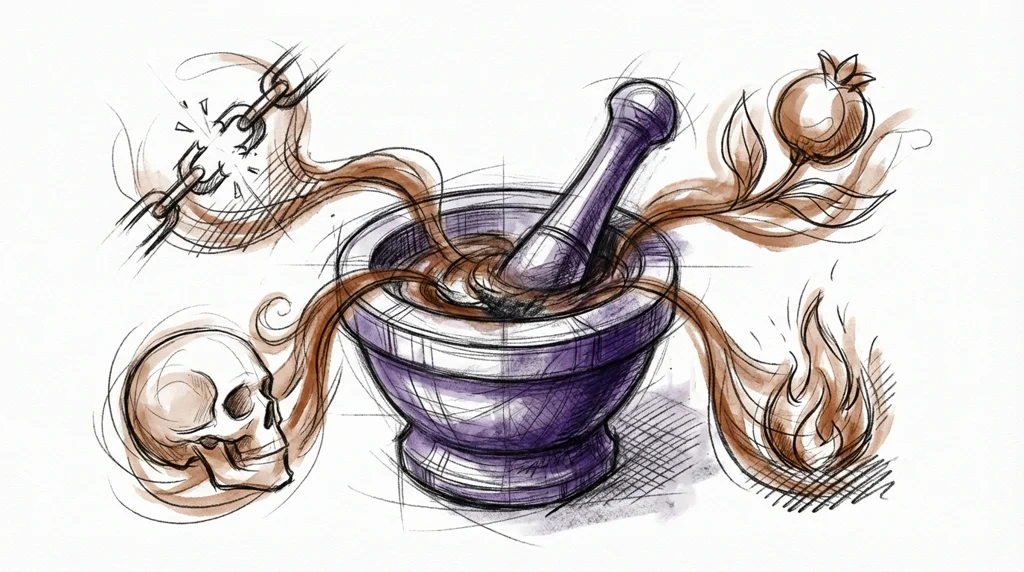
What matters clinically is not the content (Ganesh, elephants, boxes, trajectories), but the function:
Temporary relief from self-doubt and hyper-control.
Healthy integration includes:
- allowing the experience to end
- resuming ordinary identity
- reflecting without clinging
The fact that these states ended naturally is a sign of psychological health, not failure.
Why This Remains Personal—and Yet Shareable
The symbols are personal. The mechanism is universal. This distinction matters.
I cannot give someone my images or meanings—and I shouldn’t. But I can explore the conditions under which trust, clarity, and non-doership emerge.
This article is written not to teach enlightenment, but to say:
If you’ve experienced something like this, you’re not alone—and you don’t need to mythologize it to take it seriously.
Invitation
I’m interested in connecting with others who have experienced:
- non-dual or selfless awareness
- symbolic reassurance during meditation or hypnosis
- intuitive clarity that emerged when effort dropped
- states of trust that felt self-organizing rather than chosen
Especially those who want to explore these experiences analytically, clinically, and integratively, without spiritual inflation or reductionism.
If this resonates, you’re welcome to reach out and start a conversation. The aim is not answers—but shared inquiry.
References (Selected Bibliography)
- Brewer, J. A., et al. (2011). Meditation experience is associated with differences in default mode network activity. PNAS.
- Carhart-Harris, R. L., et al. (2014). The entropic brain. Frontiers in Human Neuroscience.
- Jung, C. G. (1964). Man and His Symbols.
- Josipovic, Z. (2014). Neural correlates of nondual awareness. Frontiers in Human Neuroscience.
- Kihlstrom, J. F. (2013). Hypnosis and the psychology of consciousness.
- Metzinger, T. (2003). Being No One.
- Hartman, D., & Zimberoff, D. (2011). Healing Trauma through Imagery.
- OpenAI. (2025). Analytical dialogue on non-dual awareness, hypnosis, and self-model reduction (AI-assisted conversational synthesis using ChatGPT, GPT-5.2)
Hello and wellcome!
My name is Robert Bauer. If you came here looking for assessment, therapy, advice, and psychotherapeutic guidance, then you’re in the right place.
SHARE WELL-BEING!
Do you know someone who could benefit from this article? Share it with them.